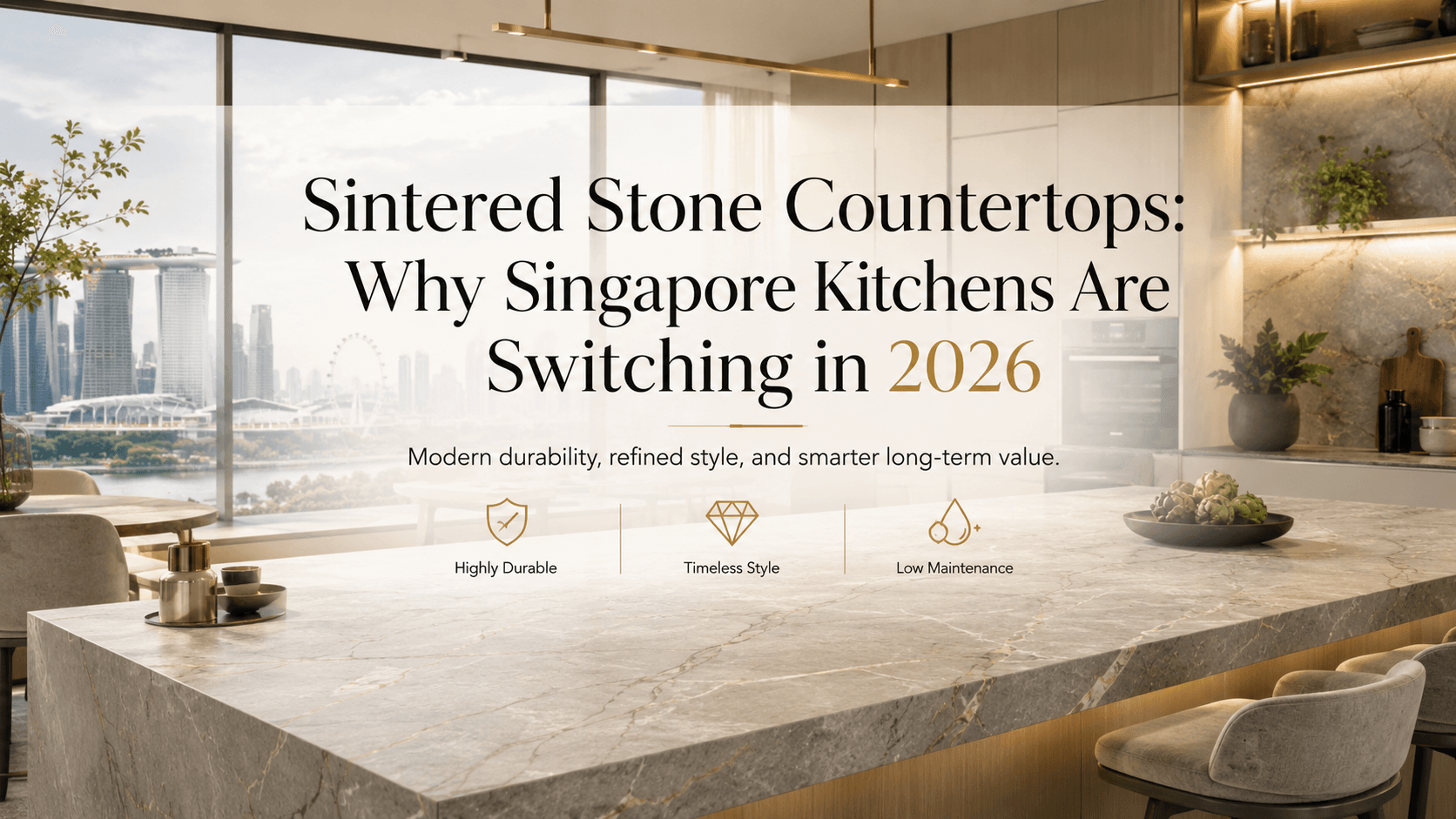
Sintered Stone Countertops: Why Singapore Kitchens Are Switching in 2026
The countertop industry is going through its biggest shake-up in twenty years. Australia has moved to ban engineered stone outright over worker-safety concerns, and the US NIOSH published a 2026 bulletin flagging that typical engineered stone runs over 90% crystalline silica. The result: manufacturers, fabricators and informed homeowners worldwide are looking hard at the next-generation alternative — and that alternative is sintered stone countertops.
In Singapore the shift is already visible in showrooms. Sintered stone used to be the exotic option ID firms specified for landed properties. Now it’s turning up in BTO kitchens, island tops and even balcony counters. Here’s what it is, what it costs, and whether it deserves your kitchen.
Already comparing slabs? WhatsApp us for sintered stone pricing on your layout, or drop a note via our contact page.
What Are Sintered Stone Countertops, Exactly?
Sintered stone is made by taking natural minerals — the same raw ingredients as granite and porcelain — and compacting them under enormous pressure and heat until the particles fuse. No resin, no binder. The process mimics what the earth does to rock over millennia, compressed into hours.
That production method is the source of every headline property:
- Extreme heat resistance. No resin means nothing to scorch. Hot pan straight from the wok burner? Can.
- UV stability. The colour won’t fade outdoors — why sintered stone owns the balcony-kitchen and BBQ-counter market.
- Scratch hardness. Harder than quartz. You still shouldn’t chop directly on it (bad for your knives, honestly), but it takes daily abuse without marking.
- Near-zero porosity. Like quartz, spills stay on the surface.
The trade-offs are real too, and any honest countertop supplier will tell you: sintered stone is more brittle at edges and cutouts, demands experienced fabricators with the right tooling, and generally costs more than mid-range quartz. A botched cutout can crack a slab — fabricator skill matters more here than for any other surface.
Sintered Stone Brands Singapore Buyers Should Know
Not all sintered surfaces are equal, and brand matters more than in the quartz world because the technology is newer. The names to know, all available in our brand lineup:
- Dekton (Cosentino): the category leader, technically an “ultracompact surface”. Massive colour range, proven track record, and the brand most IDs specify by name. We’ve covered it in depth in our Dekton countertop guide.
- Lapitec: Italian, full-body slabs — the colour and pattern run through the entire thickness, so edges and chips show the same material, not a different core.
- Regional sintered lines: increasingly good, meaningfully cheaper, and worth considering for large-format wall cladding where the budget has to stretch.
When you compare quotes, confirm you’re comparing the same thickness (12mm vs 20mm changes both price and application) and ask specifically about edge-profile options — sintered stone’s brittleness makes some fancy edges impractical.
Not sure which brand fits your budget? Message us on WhatsApp with your layout and budget — we’ll tell you straight which slab gives the best value.
Quartz vs Sintered Stone: The Honest Comparison
This is the decision most Singapore renovators are actually making, so let’s do it properly.
Where quartz wins:
- Price. Mid-tier quartz undercuts almost all sintered stone.
- Pattern variety per dollar — the marble-look quartz market is enormous.
- Fabrication forgiveness: easier cutouts, cheaper repairs, more fabricators can handle it well.
Where sintered stone countertops win:
- Heat. Trivets become optional (we still recommend them for the joint sealant’s sake).
- Outdoor and high-UV zones — quartz yellows outdoors; sintered stone doesn’t.
- Silica profile. While sintered slabs still contain silica, leading brands run far below engineered stone’s 90%+ crystalline silica content — the figure that triggered the global regulatory response documented by NIOSH. For the finished homeowner both are inert and safe; the difference matters for fabrication workers and, increasingly, for where regulation is heading.
Where it’s a tie: stain resistance, everyday cleaning, hygiene. Both are non-porous and wipe-clean.
Our durable countertop materials comparison scores these surfaces alongside granite and solid surface if you want the full matrix. And if your shortlist includes compact laminate, the Kompacplus vs quartz comparison covers that fork in the road.
Sintered Stone Kitchen Top Singapore: Design Applications
Where sintered stone earns its premium in local homes:
- Island tops with waterfall edges. Large-format slabs mean fewer joints on a statement island — some formats run to 3.2 metres, enough to do most HDB islands seamless.
- Balcony and outdoor kitchens. The only surface category we confidently spec for full sun. Singapore’s heat is not slowing down — the Meteorological Service logged 2024 as the country’s hottest year on record — and outdoor living zones keep growing in new condo layouts.
- Ultra-matte dark kitchens. The velvety matte blacks and concrete looks that dominate 2026 moodboards are mostly sintered stone. Matte quartz exists but fingerprints harder.
- Full-height backsplash continuity. Thin 12mm sintered panels let you run the countertop material up the wall for a seamless look — a detail borrowed from luxury condo show flats that works surprisingly well in compact HDB kitchens.
Pair it with an undermount or integrated sink and the whole wet zone becomes one wipeable plane — the practical payoff behind the showroom look.
Choosing a Sintered Stone Supplier Singapore Homeowners Can Trust
Because fabrication skill is the make-or-break factor, vet the supplier harder than the slab:
- Ask how long they’ve fabricated sintered stone specifically. Quartz experience doesn’t automatically transfer; the cutting parameters differ.
- Ask to see a finished sintered install, ideally with a hob cutout and undermount sink — the two highest-risk operations.
- Confirm wet-cutting with dust extraction. It protects workers and signals a professional shop across the board.
- Check the warranty covers fabrication, not just the slab. Brand warranties cover manufacturing defects; cracks from bad cutting are on the fabricator.
- Get the joint plan in writing. Fewer, better-placed joints are the mark of a supplier who plans rather than improvises.
Stone Emperor carries Dekton, Lapitec and supporting sintered lines with in-house fabrication — browse the full stone collection or come talk through your layout.
Vetting suppliers this week? Put us on the list: WhatsApp +65 8374 9096 or use our contact page. We’ll show you real installs, not just samples.
Installing Sintered Stone Countertops: What to Expect
The process runs tighter than most renovation trades if you sequence it right. After your carcass cabinets are installed, the supplier laser-templates the layout on site — never accept fabrication straight from an ID’s drawing, because walls in Singapore flats are rarely square and sintered stone doesn’t forgive a forced fit. Fabrication typically takes several working days depending on cutouts and edge work, and installation itself is usually done within a day.
Two sequencing rules save the most heartache. First, confirm your sink and hob models before templating — cutout dimensions are final on ultracompact material. Second, if you’re pairing the top with a full-height sintered backsplash, have both templated in the same visit so the veining and panel lines align. Popular Dekton and Lapitec colours are usually ex-stock locally; special-order colours add shipping weeks, so lock your slab early if your reno has a hard handover date.
Frequently Asked Questions
What is sintered stone made of? Sintered stone is made from natural minerals — quartz, feldspar, clays and mineral pigments — compacted under extreme pressure and fired at high temperatures until the particles fuse. Unlike engineered quartz, it contains no resin binders, which gives it superior heat and UV resistance.
How much do sintered stone countertops cost in Singapore? Sintered stone typically costs more than mid-range quartz and is priced per foot run including fabrication and installation. Final cost depends on brand, slab thickness (12mm or 20mm), edge profile and layout complexity. Request a quote based on your actual kitchen measurements for an accurate price.
Is sintered stone better than quartz? Each wins in different areas. Sintered stone is more heat-resistant, UV-stable and suitable for outdoor use; quartz offers more design variety at lower cost and is easier to fabricate and repair. For indoor kitchens on a budget, quartz remains excellent; for heat-heavy cooking, islands and outdoor counters, sintered stone is the stronger choice.
Can sintered stone crack? Yes. While extremely hard and scratch-resistant, sintered stone is more brittle than quartz at edges and cutouts. Most cracks result from poor fabrication or point impact on unsupported edges rather than daily use. Choosing an experienced sintered stone fabricator is the single best protection.
Can I use sintered stone outdoors in Singapore? Yes. Sintered stone is UV-stable and will not fade or yellow in direct sun, making it the preferred surface for balcony kitchens, BBQ counters and outdoor dining tables in Singapore’s climate. Quartz is not recommended outdoors because its resin content degrades under UV exposure.
Which sintered stone brands are available in Singapore? Major brands available in Singapore include Dekton by Cosentino and Lapitec from Italy, alongside newer regional sintered lines. Dekton offers the widest colour range and brand recognition; Lapitec offers full-body slabs where the pattern runs through the entire thickness.
Does sintered stone have the silica problems engineered stone has? Installed countertops of any type are inert and safe in the home. The regulatory concern documented by NIOSH and Australian authorities involves fabrication workers cutting engineered stone, which is typically over 90% crystalline silica. Leading sintered stone brands contain substantially lower crystalline silica, and professional wet-cutting with extraction manages the risk for all surface types.
Ready for a slab that takes the heat? WhatsApp us your layout and we’ll recommend the right brand, thickness and joint plan for your kitchen.