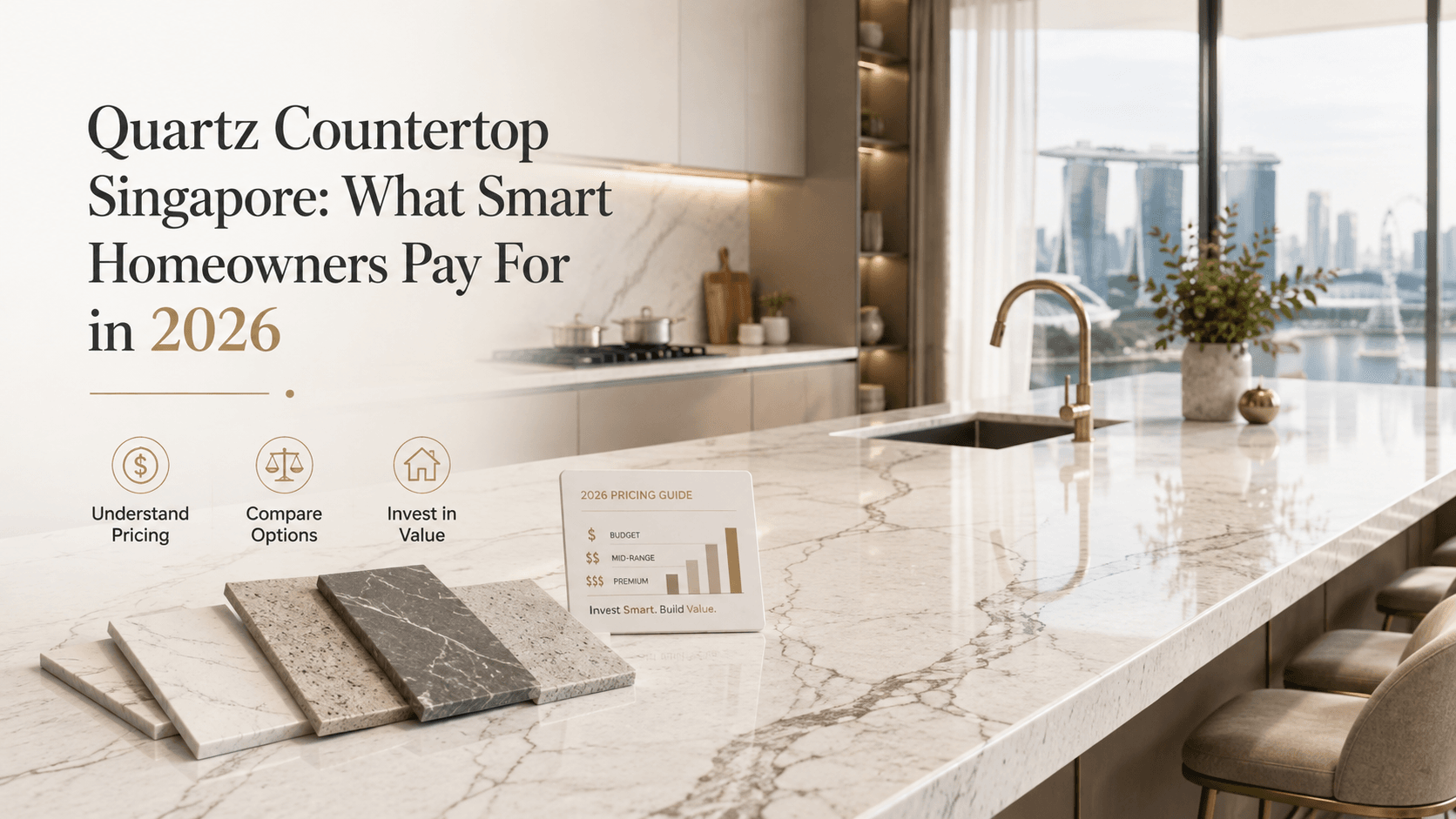
Quartz Countertop Singapore: What Smart Homeowners Pay For in 2026
HDB is launching about 19,600 BTO flats across three exercises in 2026 — February, June and October. Every one of those keys collected means another kitchen getting fitted out, and if you talk to any interior designer in Singapore right now, the same question keeps coming up: which surface goes on the kitchen top? For most homeowners the shortlist starts and ends with a quartz countertop. Singapore kitchens are small, hardworking and humid, and quartz handles all three better than almost anything at its price point.
But “quartz” covers everything from $60 per foot run to $200+, from reputable European brands to no-name slabs with warranties not worth the paper. This guide breaks down what actually matters — so you don’t overpay, and don’t underbuy either.
Renovating for a 2026 key collection? WhatsApp us with your floor plan and we’ll quote your kitchen top within the day.
Why a Quartz Countertop Suits Singapore Kitchens
Quartz is an engineered surface: roughly 90% crushed natural quartz bound with resin and pigment. That engineering is exactly why it works here:
- Non-porous. Kopi, curry, assam — nothing soaks in. No sealing required, ever. Marble needs resealing; granite benefits from it; quartz just doesn’t care.
- Consistent. The slab you see in the showroom is the slab you get. Natural stone varies lot to lot.
- Hard-wearing. It shrugs off knife nicks and daily scrubbing, which matters when your prep zone is 1.5 metres of countertop, not an island the size of a bedroom.
The one real weakness: direct heat. A wok fresh off the flame can scorch the resin. Use a trivet — that’s the whole maintenance manual.
If you’re still weighing materials, our comparison of the 4 most durable countertop materials for kitchens puts quartz side by side with granite, sintered stone and solid surface.
Quartz Countertop Singapore Price: What Drives the Quote
Prices in Singapore are typically quoted per foot run (ft run), fabrication and installation included. Three things move your number:
1. Brand tier. International names like Silestone and Caesarstone sit at the premium end — you’re paying for tighter quality control, richer patterns and warranties that mean something. Regional brands such as Aurastone or 3S Quartz deliver strong value for HDB and condo projects where budget matters.
2. Slab thickness and edge profile. 20mm is the workhorse. Mitred edges, waterfall ends and full-height backsplashes add fabrication hours, and fabrication hours add cost.
3. Layout complexity. An L-shaped top with a hob cutout, sink cutout and joint work costs more than a straight galley run. Cutouts for an undermount sink need precision work — this is where cheap fabricators cut corners you’ll see for the next ten years.
Rule of thumb: for a typical HDB BTO kitchen, quartz lands comfortably between laminate (cheaper, shorter-lived) and premium sintered stone or marble. Get two or three quotes, but compare like with like — same brand, same thickness, same edge detail. A quote that’s 30% below everyone else usually has a story you don’t want to be part of.
Want a real number, not a rule of thumb? Send us your kitchen measurements on WhatsApp or reach us through our contact page — we quote from your actual layout, no obligation.
Choosing Quartz Kitchen Countertops by Brand
Walk into any showroom and the wall of samples all look shiny. Here’s how the brands we carry actually differ:
- Silestone (Cosentino): the widest colour library in the business, including marble-look veining that fools guests at one metre. Their newer HybriQ+ formulations also cut crystalline silica content significantly — more on why that matters below.
- Caesarstone: the brand that made quartz mainstream. Dependable, classic designs, strong warranty support in Singapore.
- Aurastone / 3S Quartz: regional players with sharp price-to-quality ratios. If your renovation budget is fighting on ten fronts, this is where quartz stays affordable without going no-name.
One honest note from the trade: for pure white countertops with zero pattern, brands matter less than fabrication quality. For veined and patterned designs, brand quality shows immediately — cheap slabs have veins that repeat like wallpaper.
Quartz vs Sintered Stone: The 2026 Question
The comparison every customer asks about now. Sintered stone (Dekton, Lapitec and friends) is fired at extreme temperatures instead of bound with resin, which makes it more heat-proof and UV-stable. So which one?
- Choose quartz if you want the best pattern variety per dollar, a warmer feel, and simpler fabrication (which also means cheaper repairs and cutouts later).
- Choose sintered stone if you routinely put hot pans straight down, want an outdoor-capable surface, or love the ultra-matte industrial look. Our Dekton countertop guide covers that side in detail.
There’s also a workplace-safety angle worth knowing as an informed buyer. Engineered stone slabs are typically over 90% crystalline silica, per the US NIOSH 2026 bulletin, and uncontrolled dry-cutting has caused silicosis in fabrication workers overseas — Australia went as far as restricting engineered stone imports. The risk sits in the cutting workshop, not in your finished kitchen — an installed quartz top is inert and safe. But it is one more reason to buy from an established supplier whose fabricators cut wet with proper extraction, rather than the cheapest ad on Carousell.
Quartz Top Singapore: HDB and BTO Practicalities
A few things specific to our market that overseas guides never mention:
- Galley and L-shaped layouts dominate. Most HDB kitchens need one or two joints at most. Ask your fabricator where the joints will fall — a good one positions them away from sightlines and wet zones. Our small HDB kitchen design guide shows layouts that make a compact top work harder.
- Template before you commit. Reputable installers laser-template after your carcass cabinets are in, not from the ID’s drawing. Walls in older blocks are rarely square.
- Coordinate the sink early. Undermount and integrated sinks must be confirmed before cutting. Changing your sink after the slab is cut is an expensive way to learn about project sequencing.
- Lead time. Popular colours are usually ex-stock; special orders can take weeks. With three BTO exercises dropping keys through 2026, fabrication slots tighten every quarter — book your countertop when your carpentry is confirmed, not after.
Keys collected and carpentry underway? WhatsApp +65 8374 9096 to lock in a fabrication slot.
Caring for Quartz Kitchen Countertops (The Short Version)
This section is short because quartz care is short. Wipe with soap and water. Skip harsh solvents and abrasive pads. Use a trivet for anything straight off the stove. Don’t stand on it to change the light bulb (the unsupported span, not the surface, is what gives). That’s it — no annual sealing, no special polish, no drama. It’s why landlords and busy families default to quartz: it’s the surface that forgives.
For the full landscape of options beyond quartz — granite, marble, sintered stone, solid surface — our countertop materials guide walks through all of them.
Frequently Asked Questions
How much does a quartz countertop cost in Singapore? Quartz countertops in Singapore are quoted per foot run with fabrication and installation included. Pricing varies by brand tier, slab thickness, edge profile and layout complexity. Regional brands cost significantly less than premium European brands like Silestone or Caesarstone. Request an itemised quote based on your actual kitchen measurements for an accurate figure.
Is quartz better than granite for Singapore kitchens? Quartz is non-porous and never needs sealing, making it lower-maintenance than granite in a humid climate with heavy daily cooking. Granite tolerates direct heat better and offers natural one-of-a-kind patterns. For most HDB and condo kitchens, quartz is the more practical choice; granite suits buyers who prioritise natural stone character.
Can I place hot pans directly on a quartz countertop? No. Quartz contains resin binders that can scorch or discolour under direct high heat. Always use a trivet or heat pad for pots and pans straight from the hob. If heat resistance is a priority, consider sintered stone surfaces such as Dekton instead.
How long does a quartz countertop last? A properly fabricated and installed quartz countertop typically lasts 15 to 25 years or more in residential use. Reputable brands back their slabs with warranties of 10 years or longer. Longevity depends heavily on fabrication quality, which is why supplier choice matters as much as brand choice.
Is quartz safe? I read about silicosis. An installed quartz countertop is completely safe in the home. The silicosis risk documented by health authorities affects fabrication workers who dry-cut slabs without dust controls. Buying from an established supplier that uses wet-cutting and proper extraction protects workers and typically correlates with better fabrication quality overall.
What is the difference between quartz and sintered stone? Quartz is crushed natural quartz bound with resin; sintered stone is mineral powder fused at extreme heat with no resin. Sintered stone is more heat- and UV-resistant and suits outdoor use; quartz offers more pattern variety per dollar and simpler fabrication. Both are non-porous and low-maintenance.
How do I get an accurate countertop quote in Singapore? Provide your kitchen layout with measurements, preferred material and brand, sink and hob type, and edge profile. A reliable supplier will quote from your layout and confirm with an on-site laser template after cabinets are installed. Contact Stone Emperor via WhatsApp at +65 8374 9096 or through the contact page for a same-day quote.
Ready to shortlist your slab? Browse our stone collection or WhatsApp us for colour recommendations that fit your carpentry.